

The Frequency Illusion
How Tuning Your Attention Can Change Your Life

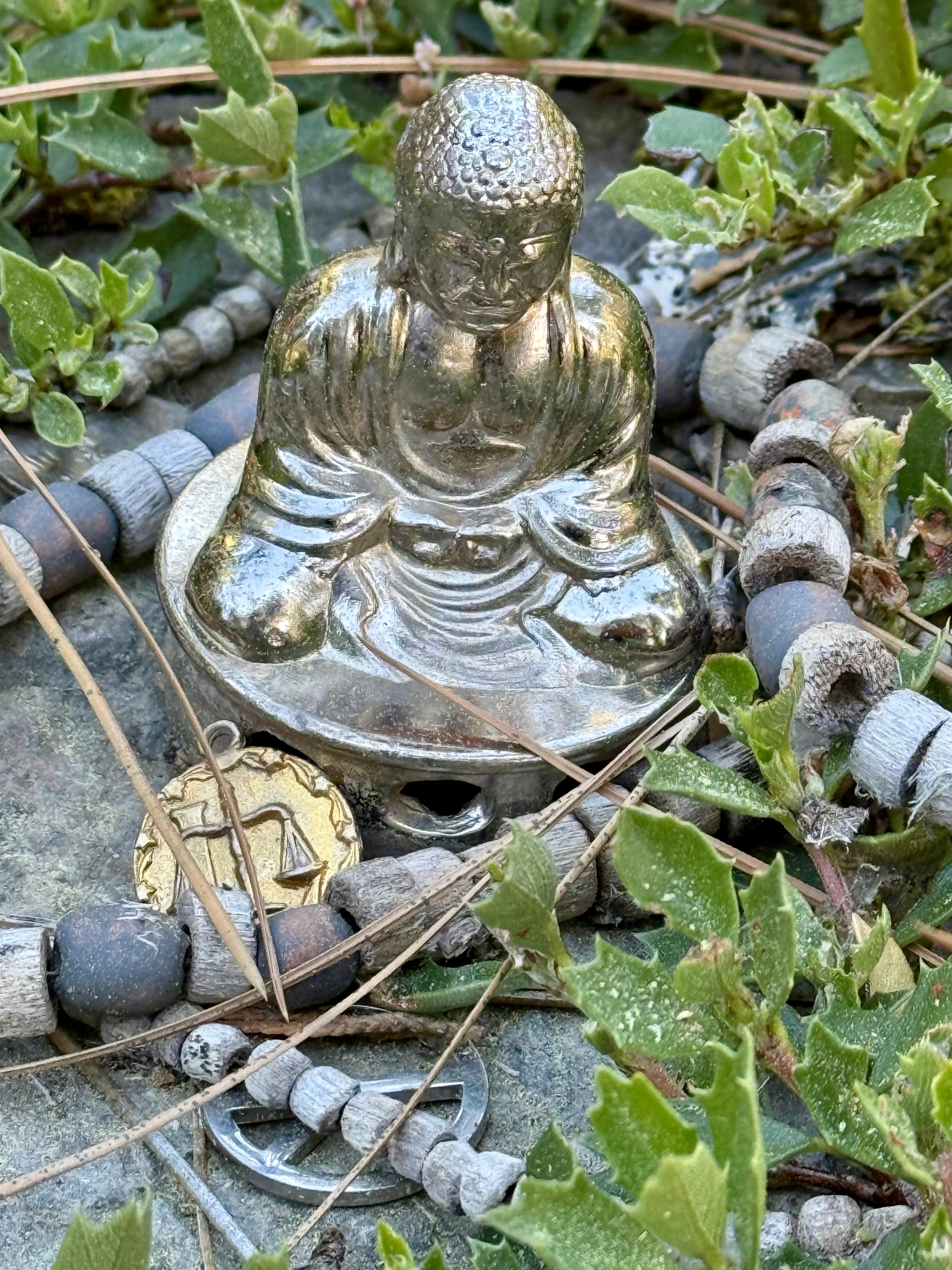
Respond to this moment with your whole heart. Be there as if it were the only moment that ever existed.
~Pema Chödrön
Hello, Friends—
I’ve been thinking about the way attention works—how once you notice one thing, you suddenly see it everywhere. It’s not that it wasn’t there before, but instead, your brain has now flagged it as relevant. The frequency at which the thing is present has not changed, but your perception has. Psychologists call this the frequency illusion or the Baader-Meinhof phenomenon.
I experienced this recently while hiking through the desert in Joshua Tree. I walked quietly, allowing my senses to tune into the subtleties of the terrain. And then, suddenly, everything started showing up. I noticed a hedgehog cactus, peeking out from under a creosote bush, its sumptuous fuchsia bloom on proud display. Once I noticed this first bloom, my eyes began picking up its shape, form, and color in the landscape. Suddenly, brilliant pink flowers were everywhere.
The same happened with the lizards. At first, nearly imperceptible for their statue-still poses and impressive camouflage, once I noticed one, they became ubiquitous.
This is frequency illusion in action—once you notice something, your brain starts flagging it everywhere. This phenomenon occurs as selective attention and confirmation bias operate together. Selective attention is the brain’s way of prioritizing certain information while filtering out the rest (we can’t process everything, so our brains make executive decisions about what matters). Confirmation bias reinforces the pattern. Every time you spot another bloom or another camouflaged lizard, your brain logs it as evidence.
Most people experience this as something that happens to them—a curious glitch, a party trick of cognition. But here’s what I’ve been sitting with: What if we could harness this deliberately? What if, instead of passively noticing what crosses our path, we actively tune our attention toward what lights us up—and in doing so, proactively shape the texture of our days?
Wild Attention as Practice
What I experienced on that Joshua Tree trail is something I’ve come to call Wild Attention—the practice of bringing full, unhurried perceptual presence to the living world around you. This goes far beyond seeing to include both visual sensing and psychological processing—organizing, interpreting, and consciously experiencing. Doing this well requires watching things with an active, inquiring mind. It’s a bit like moving from awareness to embodiment.
In the woods at the edge of the Sierra Valley (the largest alpine valley in the continental U.S.), I saw something I’d never seen before—a vibrant, scarlet spear poking out through the needle-strewn forest floor, with a fleshy body that resembled a succulent. I walked closer to inspect. It appeared to be a stalk adorned with bell-shaped flowers and thin, fringed leaves. Once I noticed one, I began to spy more—some deep in the forest. All of a sudden, they were everywhere.


Once I returned home, I needed to know more—What were these vibrant beings dotting the landscape?
Turns out, they are snow plants (Sarcodes sanguinea—which roughly translates to bloody flesh-like thing), and native to the conifer forests of California, Oregon, and Nevada. They tend to live at between 4,000 and 9,000 feet in elevation, nestle in shaded areas with heavy pine needle duff, and emerge in spring—often popping up through melting snow—and are not in any way succulents. Unlike most plants, they entirely lack chlorophyll (and thus, don’t photosynthesize); instead, they obtain sugars and nutrients by tapping into the underground network of mycorrhizal fungi that weave the forest together (mycoheterotrophy). They’ve been largely considered parasitic but evolving research suggests a more nuanced picture of their ecosystem role, including moderating the soil microbiome by selecting for specific fungal species and engaging in mycorrhizal arbitrage by exploiting inefficiencies in the biological trading markets of mycorrhizal fungal networks (i.e., gaining carbon and nutrients without harming the system). The plants are rare, very delicate, and protected by law. It seems it was a gift to experience them.
This kind of unhurried rhythm—with its heightened senses—has become almost countercultural, a form of resistance against forces that profit from our perpetual distraction. And, yet, it’s just what we need. Deep focus strengthens memory formation, enhances creative problem-solving, regulates our nervous systems, and puts us in the place where insight and meaning-making are possible. It’s truly the antidote to the anxiety, restlessness, and disassociation plaguing a society unhinged by bits and bytes.
Beyond the Trail
This same approach applies to life more generally. When you orient your attention toward what genuinely lights you up—what makes you feel most alive, most like yourself—your brain begins finding it everywhere.
And here’s where it gets interesting: the frequency illusion doesn’t just operate on things—it operates on possibilities. A mind oriented toward How do I make this happen? finds openings, serendipitous connections, and unexpected invitations. A mind oriented toward What if this goes wrong? finds evidence of danger at every turn. Your orientation impacts your experience.
Psychologist Richard Wiseman spent a decade studying luck—interviewing hundreds of people who considered themselves lucky or unlucky—and observed what differed between them. His finding was striking: luck had little to do with chance. Lucky people simply noticed more. They were more open, more relaxed, more attuned to what was around them—and as a result, they spotted opportunities that unlucky people, tunnel-visioned by anxiety and expectation, walked right past. They had very different experiences of the same world. Wiseman called it being open to chance opportunities. It seems you find what you've trained yourself to see.
This isn’t a fixed personality trait imparted at birth—it’s a practiced orientation strengthened over time. The obsession with water that carried me to MIT wasn’t a plan; instead, it was a frequency I’d tuned to so completely that the path kept revealing itself. Being able to say Yes! to a serendipitous invitation to fly fish (and to do water science) in the Amazon wasn’t luck; it landed in a life deliberately oriented toward expansion.
If you see flowers, there are flowers. If you look for openings, you find openings.
What are you tuning your attention toward?
xo Wendy


Yes! I delight in this❣️ Such a delicious practice.
The most precious currency in this distracting economy is attention 🌸👀