

How Fractured Attention Is Harming Your Brain—And Why We Need Wild Attention Now
Lessons from Joshua Tree

“To pay attention, this is our endless and proper work.”
~Mary Oliver
Hello, Friends—
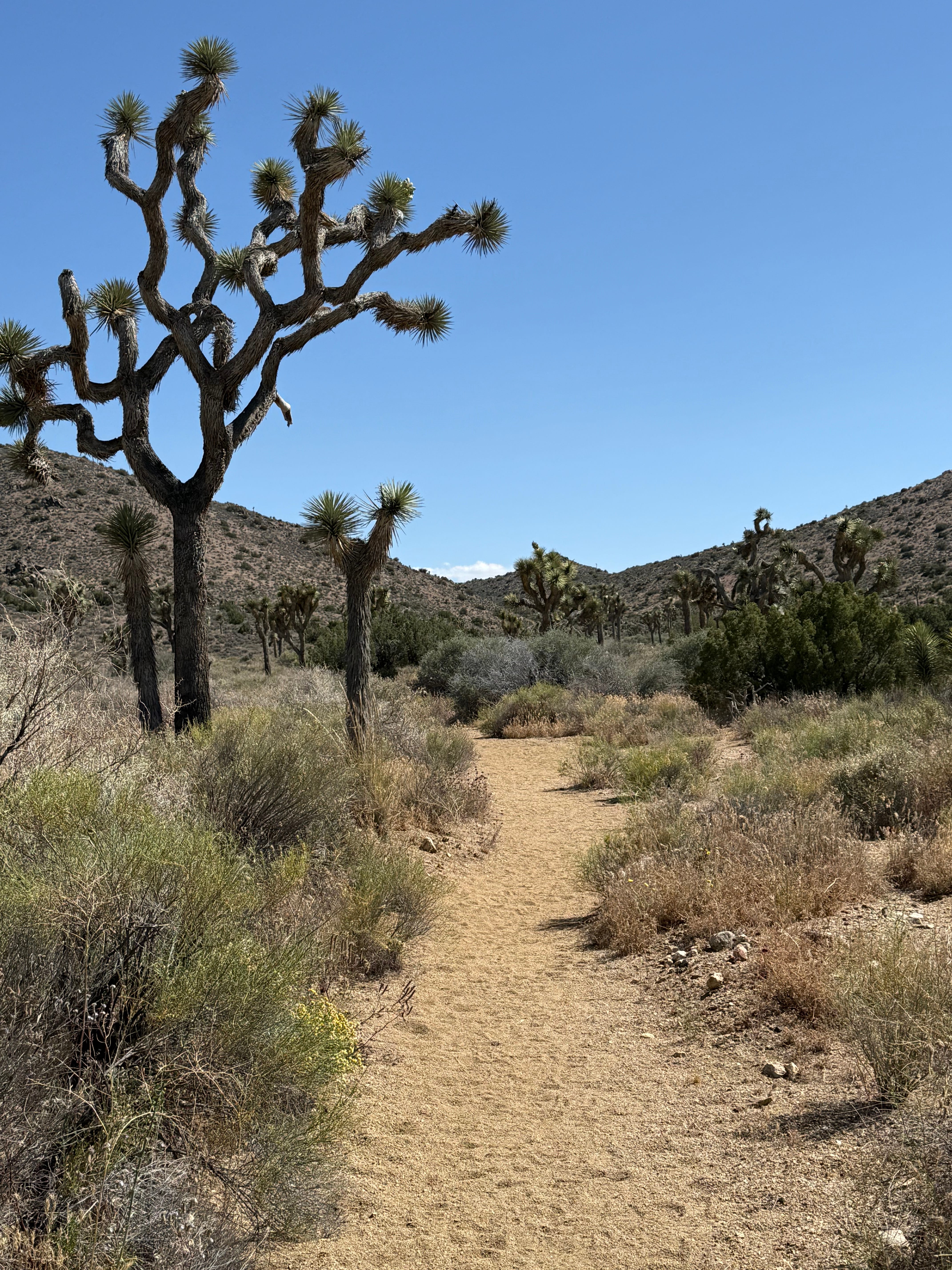
The other day, I hiked the trail away from my campground in Joshua Tree National Park, desert yawning open in front of me. The basin was full of subtle earth tones and prickly things, all juxtaposed against a cerulean blue sky and ringed by rounded granite spires, their domes sculpted by eons of wind and water. With each step, the pathway crunched with spire remnants, small crystals of decomposed granite.
This path was particularly lonesome and I encountered not a (human) soul the several hours I walked. The solitude made it easy to do little other than pay attention to my surroundings. There were junipers trees, Mojave yucca, creosote bushes, cholla cactus, the occasional hedgehog cactus, and an endless forest of Joshua Trees. Quiet walking invited the critters to stay, and patient noticing allowed my eyes to tune in to the subtleties of the terrain. And then, everything started showing up. I noticed a hedgehog cactus, peaking out from under a creosote bush, its sumptuous fuchsia bloom on proud display. Once I noticed this first bloom, my eyes began picking up its shape, form, and color in the landscape. Suddenly, there were brilliant pink flowers everywhere.


The same happened with the lizards. At first, nearly imperceptible for their statue-still poses and impressive camouflage, once I noticed one, they became ubiquitous. I saw inky blank Great Basin fence lizards, sandy Mojave fringe-toed lizards, and my favorite—the desert horned lizard. With speckled sand-toned skin on her body and spiny tail; legs and belly like a frog; and showy white head complete with dragon horns—plus her quirky movements—what’s not to love? (See for yourself.)
Then there were the tiniest of tiny ground cover flowers, and a couple washes—evident only by the shape of the remnant channel, and in places, signs of debris from a spring flash flood. A limb of a Joshua tree cut to a stump to clear the trail.
Finally, there was the scat—an old pile, ashen grey, with segments one or two inches long—right in the middle of the trail. I kept walking. Soon I saw another pile, then another. The newer piles were dark black, the older, grey or white. All of it was deposited in the middle of the trail—to mark territory, no doubt. I knew there were both bobcats and mountain lions in the area, and this scat seemed to possess the telltale signs—dense and full of hair but lacking in berries and grasses; dark when fresh but bleaching to ashen grey and white—like bone remnants left to weather. It seemed to be a bit small to be mountain lion scat but elsewhere in the area, I’d seen signs warning against hiking alone in mountain lion territory. Yet, here I was, alone, in what appeared to be prime range. Still it was the middle of a hot, sunny day, and these animals tend to be active at dawn and dusk, and so, I continued on, eventually reaching a wash, several long series of steps, and finally a high point before turning around to retrace my steps back to camp.
[Later that day, I texted scat pictures (scatological jokes aside) to a friend who’s expert in these things, and he wasn’t sure either, saying maybe it was a bit small. Still, I liked imagining these had been the signs of mountain lions.]


The trek had me reflecting on the power of attention—how the act of being entirely present, with all senses focused on the world around you, transports you to another realm. You enter a kind of meditative state—internal noise drops away, your nervous system regulates, senses heighten, and cognitive focus sharpens. You begin noticing things you might otherwise have missed. And, in this space, connection, creativity, wonder, awe, and joy are more easily accessed. It’s what I've come to call Wild Attention—the practice of bringing your full, embodied presence to the living world around you.


And, the neuroscience is clear: what I experienced on that lonesome trail—sustained, embodied attention to the living world—fundamentally rewires us. Studies show that deep focus strengthens memory formation, enhances creative problem-solving, and triggers structural changes in brain regions governing emotional regulation. When we pay full attention, our cortisol levels drop, our nervous systems shift from sympathetic overdrive to parasympathetic calm, and we access the cognitive states where insight and meaning-making occur. This isn’t merely pleasant—it’s neurologically restorative. Research on flow states and contemplative practices reveals that sustained attention enables the very experiences humans have historically considered most meaningful: self-knowledge, connection, even transcendence. We cannot think deeply about what we cannot attend to. We cannot connect meaningfully with what we glance at between notifications.
Yet, we’ve engineered an attention economy designed to prevent exactly this kind of presence. Studies document that knowledge workers on screens switch tasks every 40 seconds, we check our phones over 100 times daily, and the mere presence of a device reduces conversation depth and feelings of connection. And, the costs of these behaviors accumulate: we suffer impaired learning and memory, increased anxiety and depression, fractured relationships, sleep disruption, and a collapse of the capacity for solitude and self-reflection. Perhaps most troubling, longitudinal research suggests declining empathy and rising reports of existential emptiness—as if, in losing our attention, we’re losing access to the interior life that makes us human. The acquaintance who interrupts dinner to scroll isn’t just being rude; she’s caught in systems engineered to capture attention through intermittent reinforcement, the same mechanisms that drive gambling addiction.
What I found on that desert trail—the unhurried rhythm, the heightened senses, the quiet joy of noticing—this Wild Attention—has become almost countercultural, a form of resistance against forces that profit from our perpetual distraction. Wild Attention isn’t nostalgia for a pre-digital past; it’s reclaiming what the research shows we desperately need: the capacity to be fully present to our one precious life, to each other, to the world that blooms and scuttles, threatens and delights when we’re actually paying attention.
What are you doing to hone your Wild Attention?
xo Wendy


Currently I'm honing my wild attention by living vicariously through your wild attention. Does that count? Couldn't resist.. I love the concept of wild attention. Something akin to it has come up a couple of times today. The forest that holds you patiently while you think all your thoughts... just waiting for you to realize that, in the throws of nature, you don't need them. I can feel that acute aliveness in this piece. I'm also a total fan of Joshua Tree. I enjoyed every moment of it. Thank you. 🙏🏻
Crazy that we check our phones 100 times daily, and also not surprising - I'm definitely a part of that statistic! And your point about full attention, with all the senses, really resonates as well. I find myself struggling with that. While walking, my instinct is to often to pop in my earbuds to listen to a book or podcast or music. It's a deliberate choice to go it alone so to speak, one that I'd love to make more often. Thanks for the reminder, Wendy!