

What is Your Suitable Habitat?
Finding the Conditions that Allow You to Thrive

Each of us belongs to a particular landscape, one that informs who we are, a place that carries our history, our dreams, holds us to a moral line of behavior that transcends thought.
~Terry Tempest Williams
Hello, Friends—
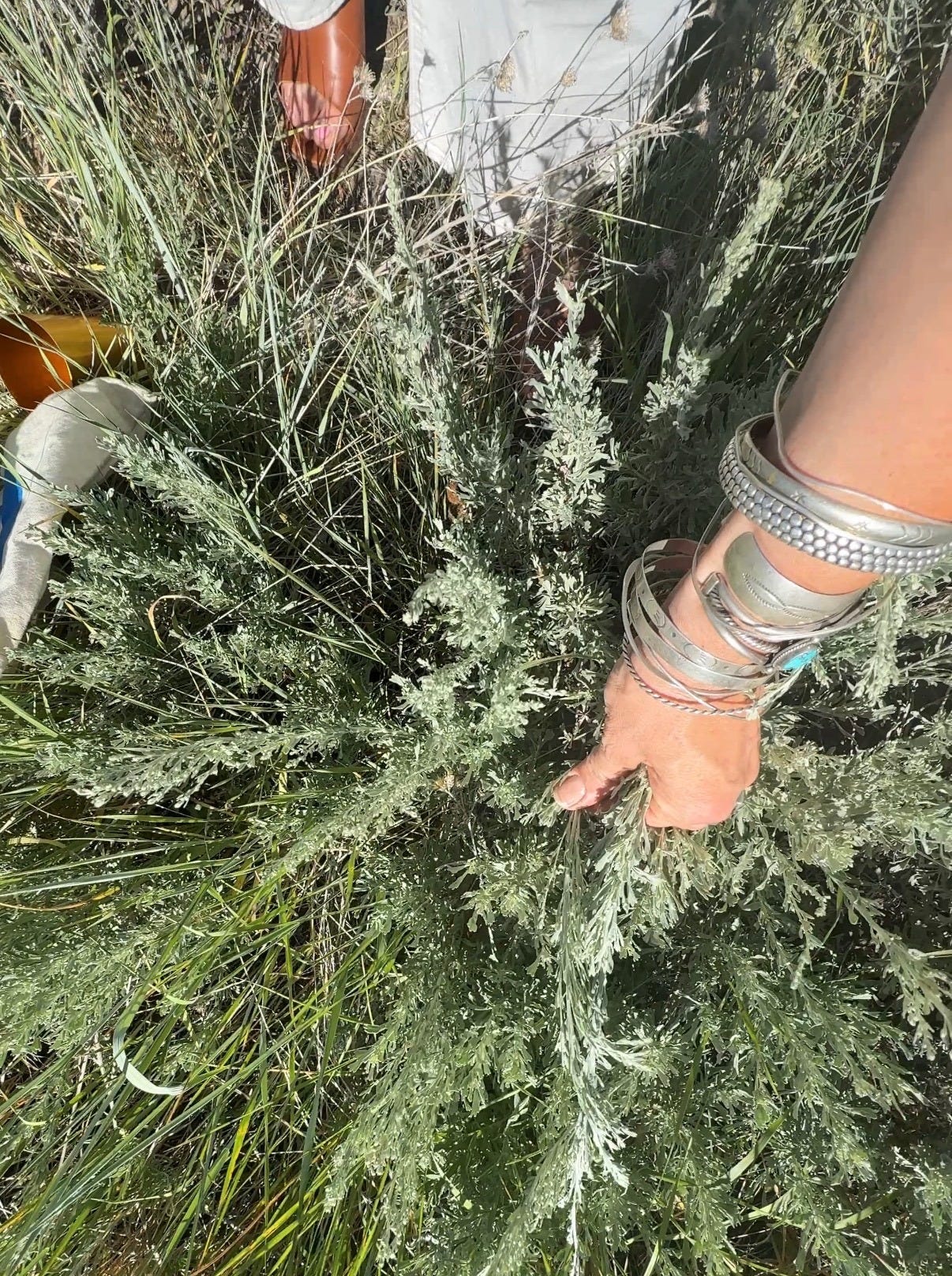
A couple weeks ago, my friends and I (one an herbalist) were charged with foraging wild sage from local hillsides near Trail Creek Cabin in Sun Valley to garnish the plates at The Living Table where I was to read my piece, You are the Place of Your Food. We were parked in the lot outside the cabin before the guests arrived, our worldly possessions—dresses, laptops, sleeping bags, cocktail fixings—stuffed in our trucks and vans. My friend handed us each a cocktail and a cloth bag and we wandered along the hillside in our flipflops, soaked up the sun, chatted, and asked the sage plants for permission to harvest from them. After filling our bags, we returned to the lot and began the transition from feral to fancy. Another friend pulled into the lot yelling Gotta love the Idaho ladies dressing in the parking lot! This is my happy place, my suitable habitat.
A while back, I wrote a piece about evolutionary mismatch (a concept from evolutionary biology that describes what happens when an organism’s environment no longer matches the conditions to which it is adapted) and how it applies to the ailments of modern life, many of which arise because we’ve created environments our species didn’t evolve to inhabit. It’s a useful lens for understanding why so many of us feel chronically stressed, distracted, lonely, and unwell.
Lately, however, I’ve been thinking about the idea from a different angle: habitat.
Habitat is a foundational concept in ecology. We often think of it as a place—a forest, a wetland, a prairie. But it’s much more than geography; it’s the constellation of conditions that allows an organism to express its full repertoire of behaviors—to feed, reproduce, rest, communicate, play, raise young, and respond to disturbance. It includes abiotic (the non-living physical and chemical elements of the environment, like temperature, soil type, sunlight, water quality, and topography) and biotic (the living components of the environment, such as the availability of prey, presence of predators, and interactions with other plant and animal species) factors. Suitable habitat is where life can fully be expressed, fully itself.
This simple ecological principle has profoundly influenced the way I see the world. As naturalists, we don’t judge an organism in isolation, but instead, look at the conditions surrounding it. If a population is struggling, we ask what has changed. If it’s thriving, we ask what supports it. Life is inherently contextual: organisms don’t exist apart from their environment; they are shaped by an ongoing conversation with it.
I’ve come to believe we’re no different. I’ve long been asking: Under what conditions do I come most alive? It’s a question our culture rarely thinks to ask.
The answer has been remarkably consistent. I come alive in days with enough space to wander. In the challenges of summiting a peak or navigating a bend in a river. In the flow state that arrives when I'm painting. In shared meals with friends and deep conversations about life, love, the universe. In coming home with an armful of wildflowers simply because they make me smile.
Once I began looking through this ecological lens, I started noticing that our culture spends an extraordinary amount of time asking what’s wrong with people. Why are we anxious? Distracted? Burnt out? Depressed?
These are important questions, but they’re incomplete. Ecologists know that when a species begins to struggle, the first place to look isn’t the organism, it’s the habitat:
Has the food source changed?
Has the water disappeared?
Has the climate shifted?
Has the community been fragmented?
Has chronic disturbance become the norm?
We rarely ask these questions of ourselves. Instead, we’ve become remarkably skilled at adapting to the modern conditions that, biologically speaking, may not suit us at all. It makes me wonder how often what we call anxiety, burnout, or dissatisfaction isn’t an individual problem but instead a predictable consequence of asking human beings to live in conditions that require chronic self-abandonment.
I’ve spent the better part of three decades experimenting with my own habitat. Every major decision I’ve made—leaving a conventional career, spending more time outdoors, building a life around creative work, choosing spaciousness over accumulation—has been less about rejecting one way of life than moving toward another that was calling to me. I was asking: What are the conditions that allow me to be more curious, more creative, more at ease?
I didn’t anticipate how much these experiments would change the way I perceive other people. As I’ve become more intentional about inhabiting the conditions that make me feel most alive, I’ve also become increasingly sensitive to people living at odds with themselves. I’ve watched artists stop making art, adventurers stop adventuring, curious people become consumed by obligation. I’ve witnessed people I love construct lives around security, expectation, and responsibility, and in doing so, dull the very qualities that make them most vibrant. Was I witnessing personality or habitat?
Perhaps this is one of the great blind spots of modern life. We spend enormous amounts of energy trying to fix ourselves while giving comparatively little attention to the conditions in which we’re trying to live. We ask people to become healthier and happier, more resilient and less anxious, but rarely ask whether the environments we’ve created actually support those outcomes.
Suitable habitat won’t be the same for everyone, nor is it something we find once and for all. Like every living system, we're continually in flux, shaped as much by unexpected disturbance as by the changing seasons of life. I’ve come to believe that one of the most compassionate questions we can ask ourselves isn’t What’s wrong with me? It’s What kind of habitat allows me to become fully myself? (And then, of course, going for it.)
xo Wendy
What is your suitable habitat?
Subscribe to unTamed Science
If you enjoy reading these posts each week, consider upgrading to a paid subscription.
For a while, I’ve had “find your tribe” bumping around in the recesses of my mind, but I infinitely prefer find your habitat. Thank you!
I'm putting this here instead of the Note:
Yes! The spacious valley where I live is such a source of calm and peace. I am eternally grateful to be here while the world explodes.
Until this past weekend, when it filled with pea-soup smoke. We shut the windows and turned on the air filters, and still my body is reacting like a cornered animal, unsure how to be. My lungs hurt and I can’t go out for a walk. My fear is that “suitable habitats” are becoming scarce.