

Mending the Divide Between Science and...Everything Else

To love a place is not enough. We must find ways to heal it.
~Robin Wall Kimmerer
Hello, Friends—
A big, warm welcome to those of you who’ve just arrived! Many of you found your way through a couple recent Notes, where, apparently, I flew my freak flag enough (i.e., owned my tendencies as a witchy scientist and shared that I’m not immune to the associated judgment (and unsubscribes)) to find my tribe. For someone who’s spent weeks—months even—in the wilderness, skis almost any terrain, is not afraid to travel alone, has repeatedly stepped off the path, and has few fucks left to give, it’s blowing me away how powerful being vulnerable online is proving to be. It’s also shone a light on the places I’m still not claiming my power. So, thank you. Thank you for the support, the validation, the wayfinding. I appreciate you.
Now, to address some of what came up in the conversation around these Notes. Some readers shared that they were also witchy scientists—hailing from disciplines that include psychology, biology, physics, environmental science, and wildlife science—or that as women, we’re all powerful, magical, and miraculous. Others wrote that they’d had similar experiences—people unsubscribing when they were too vulnerable (using words like witch, crone, and sacred feminine, writing about shamanic journeying)—or too opinionated. (Fuck that—we’re done being ‘too much’.) One woman told of how her plants grew fast and strong when she loved them, sang to them, named them, and played classical music for them. She’s also a horse whisperer. [As an animal whisperer, I can attest that animals know your energy better than most humans ever will.]
We talked of how science and magic are, at times, indistinguishable. One woman offered that we know taste buds, chemicals, synapses, combine when we taste, say, a raspberry. But that’s also pretty magical, right? The how can be explained. But the why is the magic answer.
We noted that the most famous ancient astronomers were also astrologers, that science can be politically-driven and its results dependent upon the questions asked, and that logic and intuition go hand-in-hand—you can’t have one without the other. How else will scientists have ‘aha’ moments?
One woman offered that the words Scientist and Witch describe Lucy, a strong character in her emerging story—set in the tumultuous times of 17th century England—who’s blending the old ways with a pioneering role in Natural Philosophy (what subsequently became “science”), and although we’ve heard of her famous contemporaries, she, despite being ahead in some ways, remains unrecognized.
The best compliment I received? I think you are my spirit animal.
I couldn’t love all of this more.
What’s knocking around most loudly for me today are questions around the false dichotomies society has constructed between science and spirit, science and art, science and intuition, science and traditional ecological knowledge—and how community is gathering here in recognition that these schisms need mending.
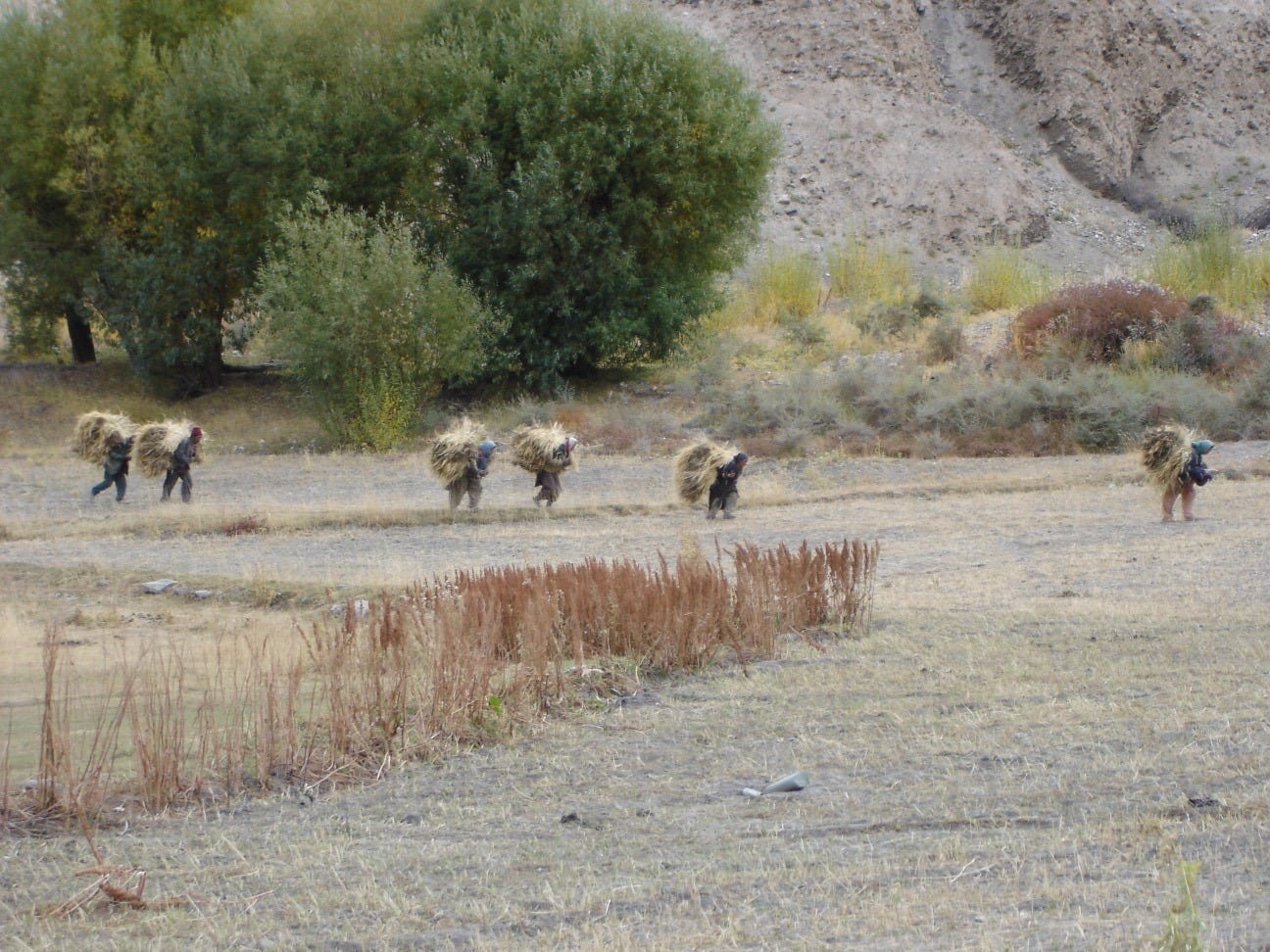
I’m reminded of the time I spent over twenty years ago as an instructor for a semester-long field course in Ladakh, India, a course that focused on natural history, sustainable development, and wilderness skills. Ladakh—or Land of Many Passes—is a remote and starkly beautiful high desert land perched in the western Himalayas. The landscape is magical and, while entirely remote, it’s also very much a cultural landscape, dotted with occasional and tiny villages perched at 15,000 feet, and replete with animals, mud houses, stone walls, fields, and mani walls, stupas, gompas, and monasteries in the most unlikely spots. At the time, the region had only recently been opened to tourism and was rapidly transitioning from a traditional, sustainable agrarian society to a tourist-based economy. It was already facing myriad issues including degradation of water resources, loss of pastoral landscapes, and erosion of cultural integrity.


What I saw there transformed my understanding of what it meant to live sustainably—people used advanced methods to survive in this high, alpine desert: houses were built of mud and straw—they were of the earth; waste was recycled, with yak patties drying on garden walls, later to be used as cooking and heating fuel, and human waste processed in dry compost toilets; mirrored, parabolic reflectors were used to focus sunlight for cooking; water was carefully tended in ancient waterways; food was dried and stored for winter. For 1,000 years, Ladakh thrived as a culture balancing human needs with the strict limits of a high-altitude desert. The society was completely self-reliant, produced zero waste (everything from human waste to animal hair was recycled), had strong community cooperation, and was devoid of poverty and hunger.
And then we Westerners showed up. In response to the influx of tourists, locals started building guesthouses on former arable lands and outhouses with running water to replace dry compost; they installed septic systems, brought in plastic, and started unraveling a delicately balanced society and ecosystem. Young people began migrating to the city, leaving their families behind, and the social fabric began fraying.
It was heartbreaking to see—Ladakh was losing the accumulated, generational knowledge around how to live within ecological limits, the very kind of wisdom our false dichotomies have taught us to dismiss as primitive. I can only imagine what’s happened since.
Clearly, there’s no going back. Still, there is so much we can learn from these ancient cultures about existing in harmony with our surroundings. Many good people are returning to these concepts—regenerating soils in our farming systems; designing biophilic and living buildings that harvest sun and water, use self-healing materials, and replenish the ecosystems around them; and standing alongside Indigenous nations reclaiming formal authority over the lands and waters their ancestors managed for millennia.
We each have a role to play in this healing. It begins here—sharing ideas about how we might mend these schisms and better honor the planet. I’m so glad you’re here!
xo Wendy
I’m curious to know what brings you here and what kinds of things most interest you. Please share in the comments.
Subscribe to unTamed Science
If you enjoy reading these posts each week, consider upgrading to a paid subscription.
I hear you. As far as I’m concerned, the way some dismiss other types of knowledge as inferior is nothing but colonial arrogance in a new, scientific guise. It’s silly, when really science could learn so much - imagine the insights we’d unlock if they went hand in hand instead of being pitted one against the other.
This resonates. I grew up in the Northeast Himalayas. I have personally expected the generational knowledge that permeates the indigenous traditions. This knowledge is the distilled experience of generations. And it works. The constructive role scientists should play would be to explain why the traditional methods work through science. It's easy to dismiss this knowledge as backward or superstition. When science brings genuine insights to why something like this works, that brings new insights and satisfaction. That is how knowledge, whether traditional or modern, must work in harmony. Then it becomes true knowledge: greater than the sum of both.