

I Need the Sea Because it Teaches Me
(plus Some Cool Science)

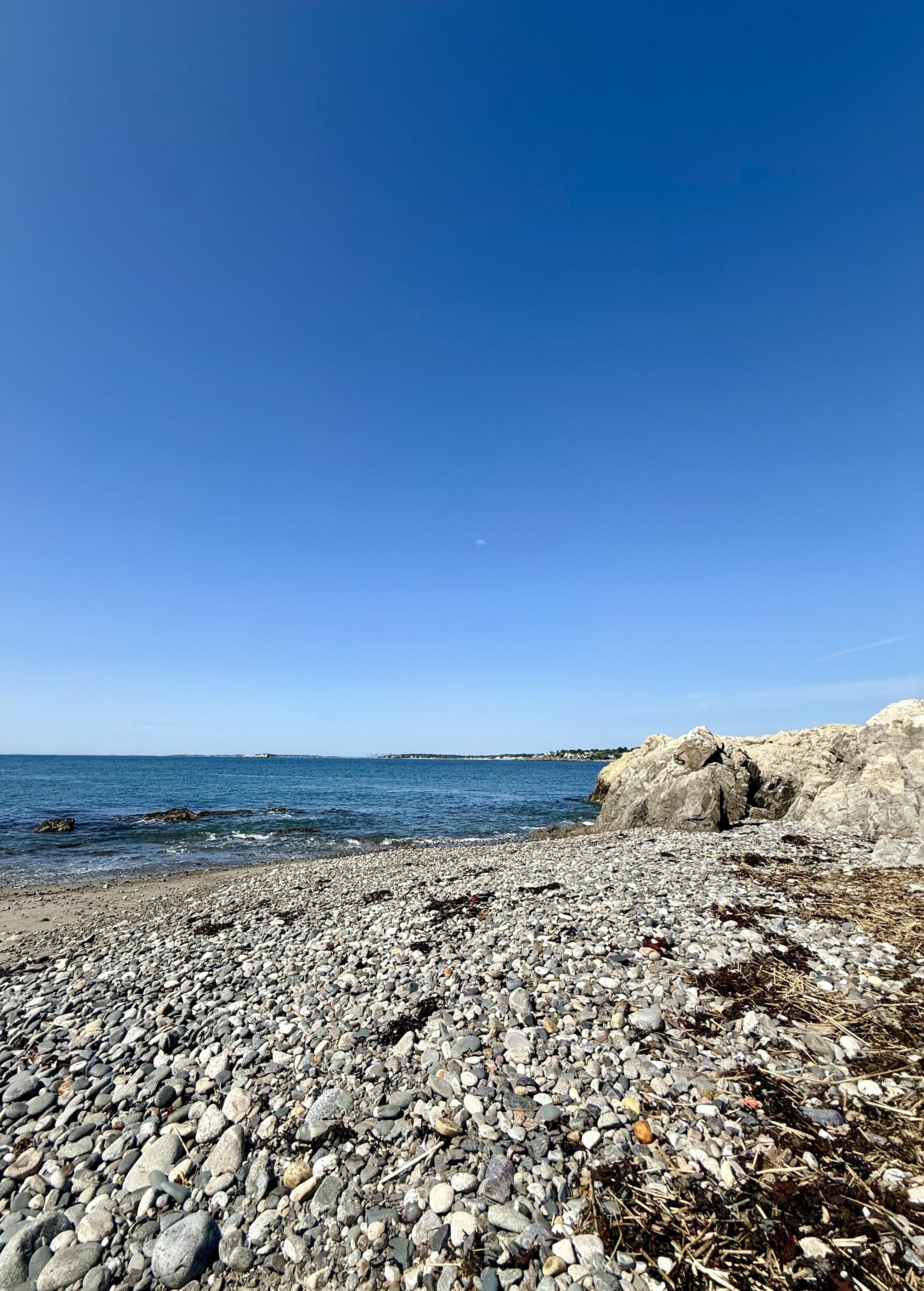
I need the sea because it teaches me…
~Pablo Neruda
Hello, Friends—
I spent a recent morning at one of my favorite coastal spots—a nook of a beach nestled between granite outcroppings—doing little more than watching families of sea ducks bob in the waves and dive for food. I soaked up the sun, read a bit, took an occasional dip. This is the place of my childhood, the waters that taught me so much about how the world works. The ocean was my first teacher, but there have been others—other teachers, other lovers. The oceans, then the rivers and the mountains and the deserts and the forests; all have informed so much of my writing—and so much of my way of being.
I’ve written about how the natural world teaches us about duality, reciprocity, impermanence, flow; how one thing in the universe is hitched to everything else (to paraphrase John Muir); how connecting with nature helps down-regulate our nervous systems. More recently, I’ve been writing about the false dichotomies society has constructed around science and everything else, and as a result, how we, as individuals, often find ourselves stuffed into ill-fitting boxes that accommodate only parts of us. (The how and why we’ve agreed to these boxes is perhaps fodder for another post.) And then, about how integration—integrating all of us, all at once—is where it’s at.
It’s little wonder, then, that as I sat on the beach re-reading forest ecologist Suzanne Simard’s Finding the Mother Tree, her words stopped me in my tracks: The forest is an integrated whole. Actually, the whole of her sentence stopped me in my tracks—My childhood was shouting at me: The forest is an integrated whole. I’d read her words before, but this time the resonance was uncanny.
[Simard’s book illuminates how “trees…are a complicated, interdependent circle of life; that forests are social, cooperative creatures connected through underground networks by which trees communicate their vitality and vulnerabilities with communal lives not that different from our own.”]


I know this path, this childhood connection, this insatiable curiosity about the world. The science and the mystery and the awe. The adventures and skinned knees and dirt eating.
And, long ago, I’d come to a similar awareness: all that I understood as a child—gained through direct observation and direct contact (and later dissected as an academic (yes, so very valuable))—was reinforced, widened, deepened each time I went to the wilds. The backpacking and the river rafting and the skiing; the grizzlies and the bald eagles and the gleaming lakes; the wayfinding and the weather navigating and the avalanche awareness; the friendships, the cooperation, the struggles. All of it built a knowingness, a groundedness, a connectedness—an inexplicable sense of wholeness—that mirrored what I knew as an academic.
Water is the great integrator. As it moves around the globe, water links air, land, and living organisms through physical flow, nutrient transport, and climate regulation. And, we can trace these movements through chemical and biological signals. The sea ducks that were bobbing in the waves that day are part of this story.
Ready for some cool science?
Hydrogen and oxygen (the stuff of water) come in several isotopes (that is, the element has the same number of protons but a different number of neutrons and thereby has a different atomic mass). Oxygen has three stable isotopes and hydrogen, two. This means that water molecules (H2O) can have slightly varying masses. What’s particularly cool about this is that heavy and light water molecules evaporate and condense at slightly different rates—lighter molecules evaporate more easily than heavier molecules and condense more slowly, causing isotopic fractionation. So, as an air mass moves inland or gains elevation, its isotopic signature (the ratio between heavy and light isotopes) changes. Each time an air mass rises and cools to the point of condensation, heavier water rains out, leaving lighter water behind. Because of this Rayleigh Effect, we can distinguish coastal air masses from inland air masses from higher elevation air masses, and equatorial air masses from higher latitude air masses—and map the whole thing.
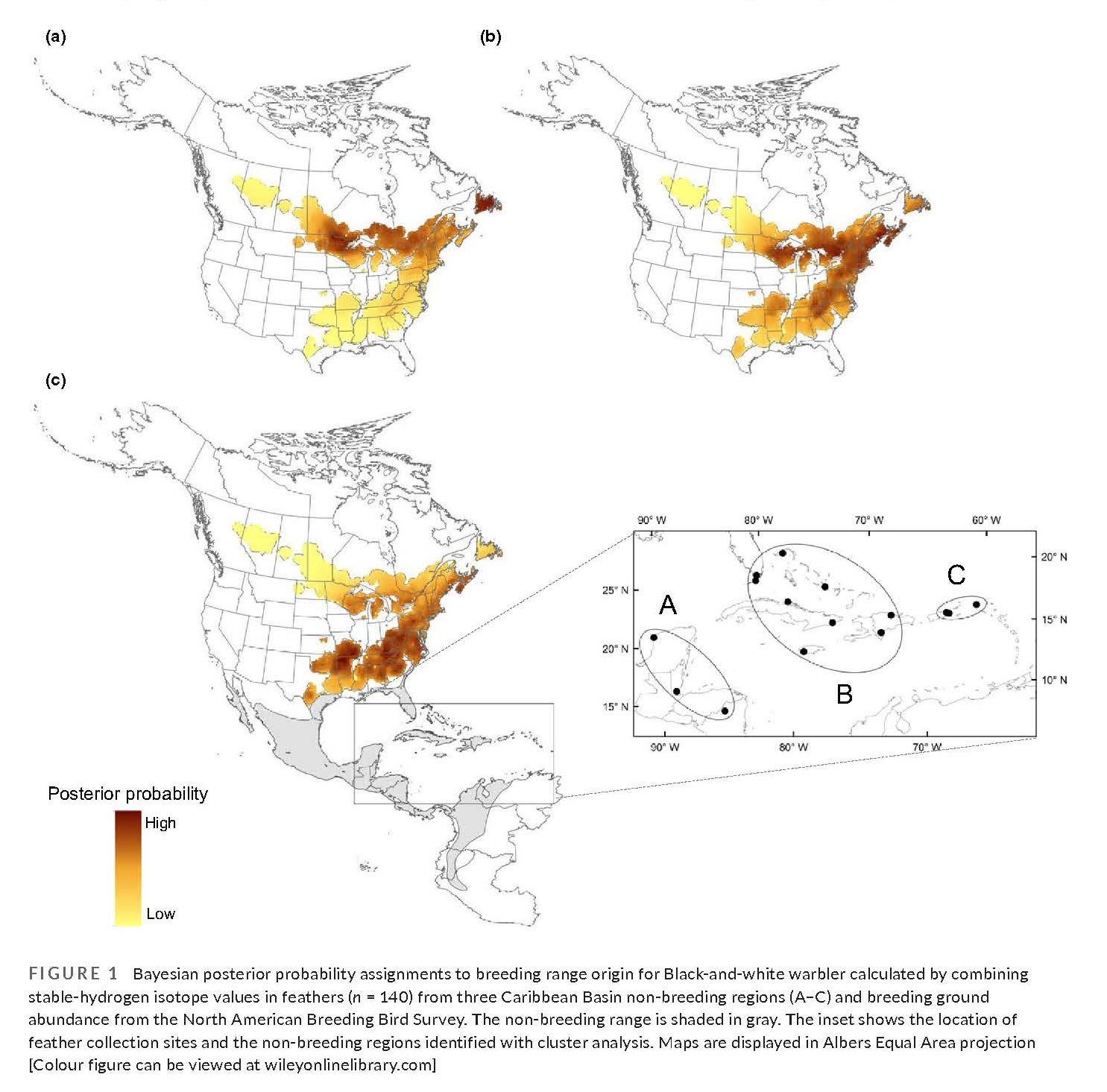
And, this is where the birds come in. Birds ingest water as drink and food, ultimately incorporating the water into their bodies. In a bird’s feathers, hydrogen and oxygen (from water, and, in the case of oxygen, from atmospheric O2 too)—plus a slew of other elements—are incorporated and stabilized into keratin. Once there, isotopic fractionation ceases and the feathers become a signal of the location from which the water originated. By measuring the ratios of hydrogen isotopes (and sometimes oxygen isotopes), scientists can then reconstruct the global migratory patterns of these birds. For example, in one study of black-and-white warblers, scientists used stable isotopes to map the probability that birds found in non-breeding grounds in the Caribbean (grey regions) originated at breeding grounds in the North America (colored regions).1 The feathers of the sea ducks would likely tell similar stories.
This intellectual understanding is one thing (and a pretty cool one at that), but the felt experience—of sitting at the beach watching the sea ducks, of floating and swimming and breathing, in unison with the whole of the sea—is what brings the knowingness that being all of me, all at once is the most powerful way I can show up.
xo Wendy
I’m building The Coven as a place for you to examine what’s limiting your ability to show up as all of it, all at once. Read on for more and let me know of your interest.
Studds, C. E., Wunderle, J. M. Jr., Kyser, T. K., Marra, P. P., et al. (2021) Strong differences in migratory connectivity patterns among species of Neotropical-Nearctic migratory birds revealed by combining stable isotopes and abundance in a Bayesian assignment analysis. Journal of Biogeography, 48(7), 1675–1688.
I really appreciate this mix of science and naturalist observations + witchy
"The forest is an integrated whole."
I think there's a whole lot to unpack in that single line. I love how you weave together science, wonder, awe, and nature.. not as separate ideas, but as interconnected ways of understanding the same world. Thanks for sharing.