

Boundaries in Nature, Boundaries in Life
Why Boundaries Must be Embodied not Just Intellectualized

Friends—
We’ve all heard the adage, ‘No’ is a complete sentence. I couldn’t agree more: setting appropriate boundaries is critical to our emotional wellbeing and one of the most important skills we can learn and exercise. I’ve found that the more grounded and centered I’ve become, the more adept I am at setting necessary boundaries; the more I set necessary boundaries, the more grounded and centered I become. (Plus, saying No opens up space for more life-enhancing, juicy Fuck Yeses.)
Recently, life has tested me with the need to draw boundaries. It has me contemplating the whole concept.
Discussion of boundaries in our interpersonal interactions has gone mainstream, migrating from the quiet corners of the therapist’s office to a viral affair, splayed across every corner of the internet. No doubt, these conversations can be offered as very useful information by qualified mental health practitioners. (In fact, these practitioners were at the root of the Insta-therapy movement). Often, however, they show up as wellness-influencer slop (accompanied by offers of coaching and courses and workshops) that teeters into dangerous territory. The problem isn’t boundaries, its boundaries that remain intellectual rather than embodied. People armed with therapy-speak (not all of which is accurate) are weaponizing it without having done the necessary integration—papering over bad behavior with words, spiritually bypassing unacceptable situations, and reacting from ingrained patterns rather than newly-learned intellectual concepts. Our body, emotions, thoughts, energy, soul, and more need to be onboard for us to clearly and confidently decide and respond in ways that honor us. A new concept, like setting boundaries, must be integrated (connected) between our intellect and all these other parts of our being for it to become our grounded reality, a skill we can cleanly exercise. Practices that revolve around doing and being can help with integration: dancing, playing, making art and music, journaling, bodywork, breathwork, yoga.
Because connecting with the natural world provides me such a powerful means of centering and grounding; deepening self-knowledge, confidence, and courage; and integrating concepts that might otherwise remain intellectual notions only, I’ve been thinking about boundaries in the natural world. And, guess what? They are everywhere, and each provides insight into the shape, function, and necessity of our personal boundaries.
Boundaries in nature range from the obvious physical ones, like rivers, mountain ranges, deserts, and oceans, to more subtle ecotones (the edge places between ecosystems; these are generative boundaries alive with biogeochemical fluxes and transformations and species interactions), to tiny-but-mighty, invisible cellular membranes. These selectively-permeable barriers may be the best analog to our personal boundaries, providing lessons in discernment by determining what enters, what leaves, and what stays out.


We have watershed boundaries—invisible but to the trained eye—that determine where water flows, what nourishes what, which ecosystems are woven together. Our greater communities—really, the container we create for our individual lives—might be viewed in the same context: What are we choosing to nurture? Where are we weaving community? What energies are we allowing into our lives?
We have boundaries between tree roots and mycelium, where each remains a separate organism, yet together, exchange nutrients, carbon, and even warnings. These mycelium networks demonstrate that healthy boundaries don’t preclude generosity. Animals define territorial boundaries through song, scent, posture, or color. A bird sings, not to dominate, but to say, This is occupied. (Note to self: Clear signals help reduce conflict, conserve energy, and reduce harm.)


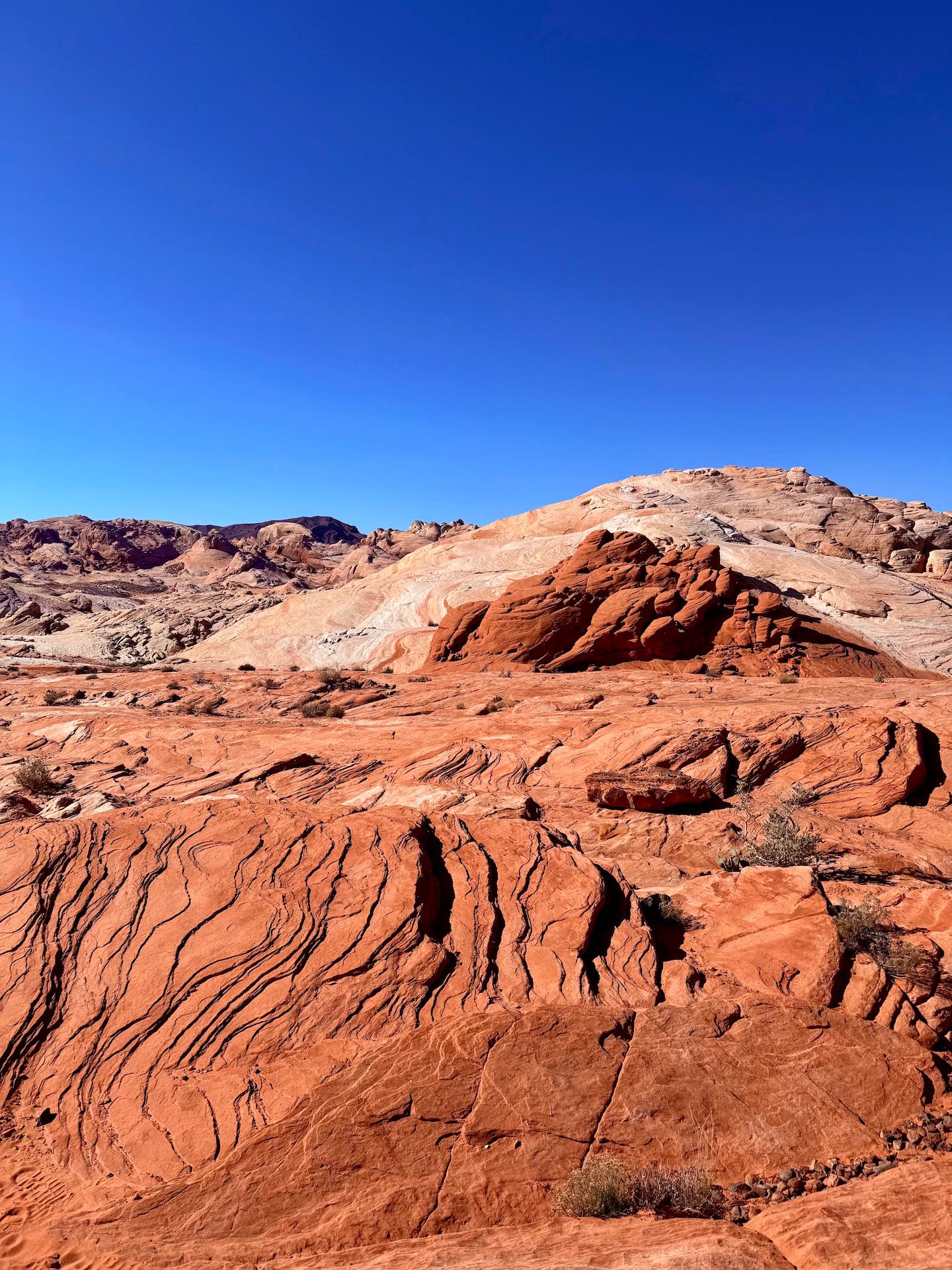
Geologic boundaries take many forms: lithologic contacts where one type of rock meets another; intrusive contacts where hot magma alters the surrounding rock; and stratigraphic boundaries between layers of sedimentary rock that record shifts in environmental conditions. The rocks themselves become a ledger of these events. In the same way these rocks are recording the stories of the ages, our bodies are cataloging our life experiences—including legacies of love, nurturance, and healthy boundaries, as well as disturbances and trauma that arise when boundaries are weak or violated.


Finally, we have more esoteric concepts like planetary boundaries. (The planetary boundaries framework was developed in 2009 by a group of scientists to describe and track the nine “processes that together maintain a stable and resilient Earth system”. These boundaries are: biogeochemical flows, freshwater change, land-system change, biosphere integrity, climate change, stratospheric ozone depletion, atmospheric aerosol loading, and ocean acidification. Scientists assessed that in 2009, we’d crossed 3 of these boundaries; by 2025, 7 had been crossed.) (Mother Nature does not like having her boundaries crossed, and frankly, we’re in for it. The same level of disrespect we’ve demonstrated to the planet, we often demonstrate to ourselves and others. None of us like it.)
Observing boundaries in nature provides not just intellectual awareness of their necessity and power, but an opportunity for a felt experience of them. For instance, you may find awe settling in as you observe the grand scale of a mountain looming in the distant, stalwart, all-knowing, resilient. You may tune in to the rhythm of your own breath—an act that inherently serves to down-regulate your nervous system. Touching the earth, herself, helps us to quite literally ground, creating an electrical contact and transferring electrons from the earth into your body. These electrons remove the positive charges we carry around, thereby acting as natural antioxidants. And, the simple act of observing nature’s boundaries becomes its own act of quiet regulation.


When we learn to see boundaries as life-giving rather than limiting, saying No becomes an act of alignment—with ourselves, with others, and with the natural world.
To healthy boundaries.
xo Wendy
This is a really beautiful way of reframing the concept of boundaries to something that isn't just helpful but completely necessary and essential to our nature. I'm one of those people who struggles with setting healthy boundaries from time to time, although I've come a long way. So anything that helps me see boundaries as useful is welcome!
This is gorgeous. To say 'nature has so much to teach us' is almost trite in the shadow of such a piece. If we understood boundaries (collectively) we would not be destroying so much of the earth. Her gentle (and more recently not so gentle) ways of illustrating her boundaries are falling on deaf, greedy ears. But if we can learn to listen in time, and perhaps learn where we end and everything (and everyone) else begins, we might just survive as a species. Whether we do or not won't matter one bit to this earth in the long-term. If only you had a mailing list of 8.24B people, Wendy. They all need to hear this as much as I did.